
Part 2 - Building FRANK
What We Built (And What It Replaced)
Over the past year, working with Claude as an AI co-builder, we've developed a suite of custom tools that don't just replicate what SaaS platforms offer. They surpass it. Because every feature, every metric, every dashboard was built for exactly one purpose: answering the questions that actually matter to our business.
Let me walk you through what we've built, what each module replaced, and—critically—what it can do that the subscription version never could.
ADMan: The Advertising Intelligence Layer
**What it replaced:** Separate dashboards for Google Ads, Microsoft Ads, Meta Ads. Third-party ad reporting tools like Supermetrics, Funnel.io, or AgencyAnalytics. Monthly cost: $300-$600.
**What we built:** A unified advertising management system that pulls data from every ad platform we use, normalizes the metrics into a common language, and presents cross-platform performance in a single view.
But here's what makes ADMan fundamentally different from any SaaS reporting tool I've ever used: it understands attribution the way a business owner needs to, not the way an ad platform wants you to.
Every ad platform has a different definition of a "conversion." Meta uses a 7-day click, 1-day view window by default. Google uses a 30-day click window. Microsoft has its own model. When you look at these platforms individually, the numbers add up to more total conversions than you actually had—because they're all taking credit for the same sales.
ADMan doesn't just aggregate the numbers. It reconciles them against actual WooCommerce transactions. We know exactly what was sold, when, and for how much. So when Google Ads says it drove 50 conversions and Meta says it drove 35, and we only had 60 total orders—ADMan shows you the overlap, the true platform contribution, and the real ROAS.
We even solved what we call the "72-hour data shift problem." Meta's reporting API doesn't finalize data for up to three days. If you're making budget decisions based on yesterday's numbers, you're making decisions on incomplete data. ADMan accounts for this automatically, flagging data that hasn't settled and adjusting historical comparisons accordingly.
No SaaS tool I've ever used does this. Most of them just pull the API data and present it at face value—because building real reconciliation is hard, and it doesn't help them sell more subscriptions.
**Cost savings:** $300-$600/month in tools, plus the incalculable value of making advertising decisions based on reconciled data instead of platform-inflated vanity metrics.
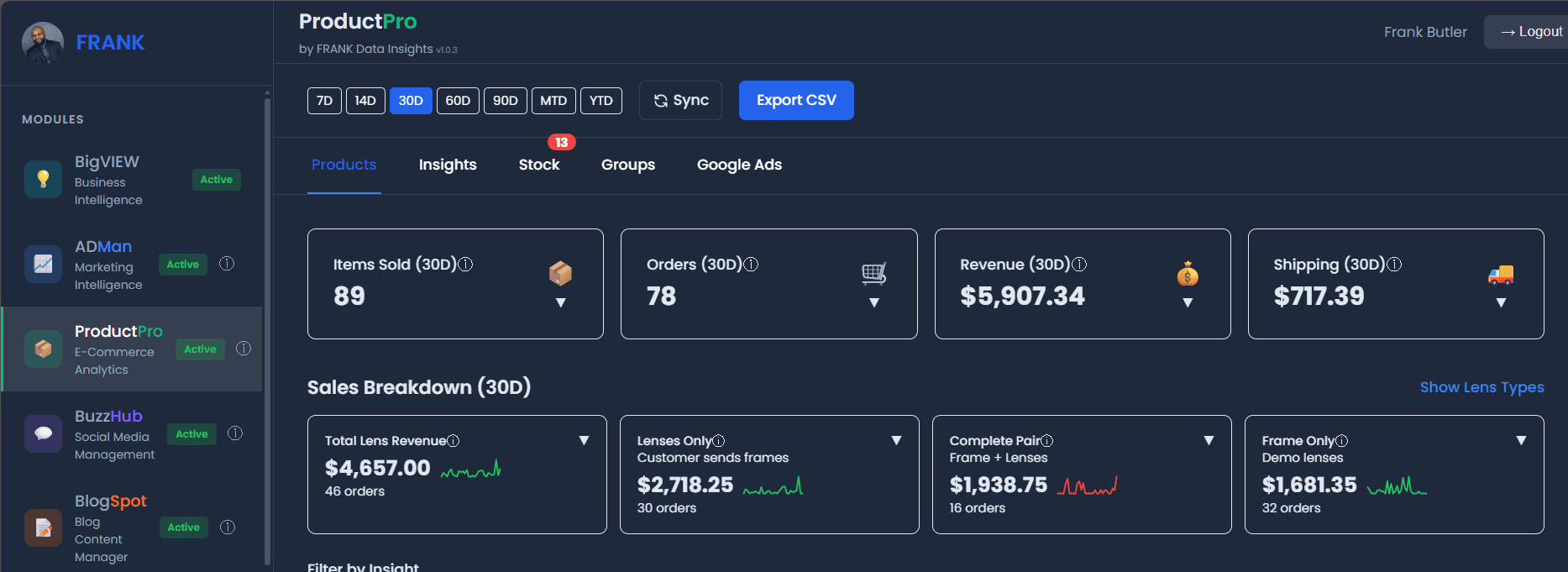
ProductPro: Product Analytics That Actually Drive Decisions
**What it replaced:** Disparate reports from WooCommerce, Google Analytics, and spreadsheet-based margin analysis. Partial overlap with tools like Glew.io, Metorik, Zoho Inventory or Daasity. Monthly cost: $200-$500.
**What we built:** A product analytics engine that scores every product in our catalog across 15 dimensions—not just revenue and units sold, but engagement rate, margin contribution, return frequency, search impression trends, stock velocity, and a composite health score from 0 to 100.
ProductPro does something I've never seen in an off-the-shelf tool: it identifies what we call "Hidden Gems" and "Silent Killers."
Hidden Gems are products with strong engagement metrics and healthy margins that are underperforming on revenue—usually because they're buried in the catalog or not getting advertising support. These are products one adjustment away from becoming top performers.
Silent Killers are the opposite: high-revenue products that look great on the dashboard but are actually eroding profitability when you factor in return rates, support costs, and advertising spend required to maintain their sales volume.
A SaaS analytics tool will show you a revenue leaderboard. ProductPro shows you which products to invest in, which to phase out, which need a price adjustment, and which are one stockout away from disappointing your best customers.
We also built automated stock monitoring that integrates with our actual supplier lead times—not a generic "reorder when stock hits X" formula, but calculations based on real supplier performance, seasonal demand patterns, and current advertising commitments that might spike demand.
**Cost savings:** $200-$500/month in tools, plus smarter inventory decisions that reduce both stockouts and dead inventory.
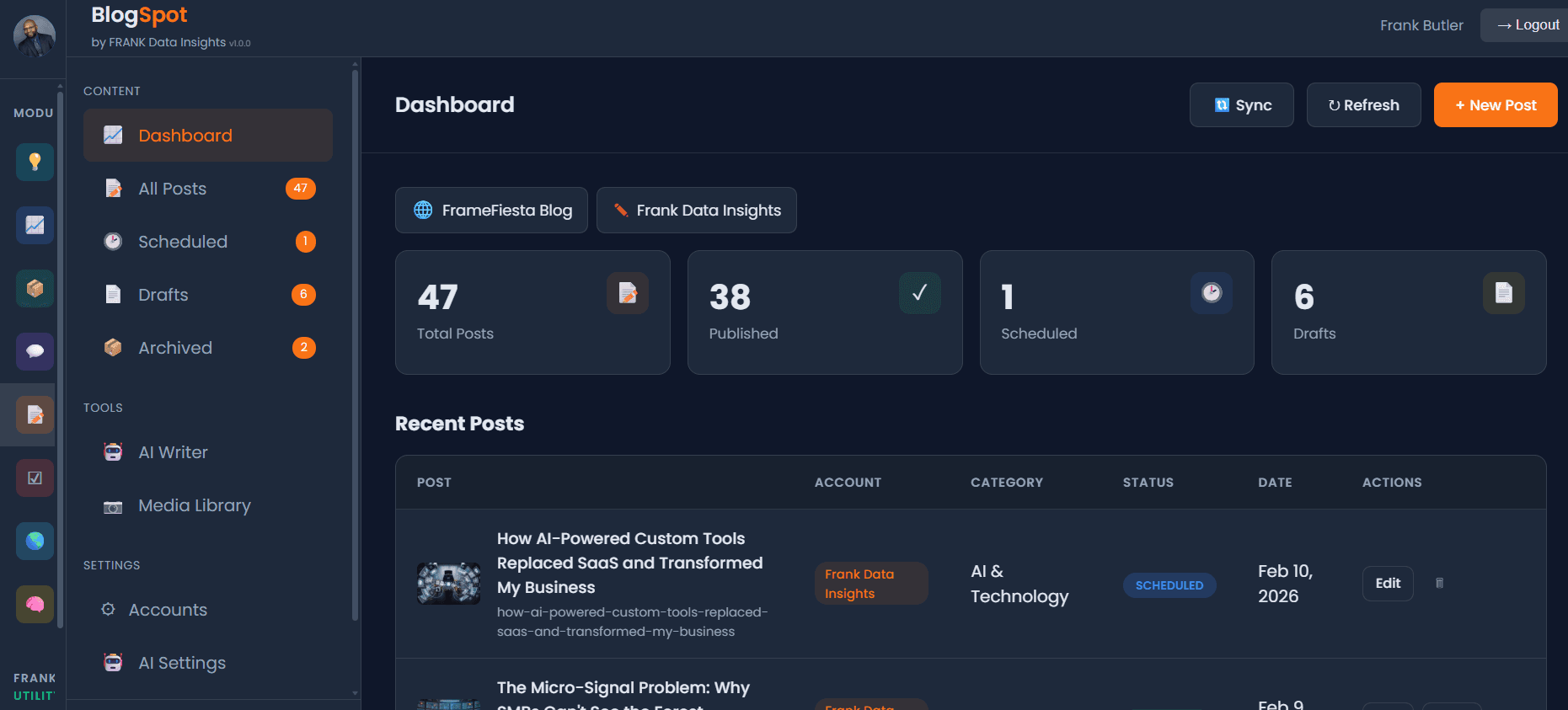
BlogSpot: Content Management Without the Platform Tax
**What it replaced:** Separate interfaces for WordPress and Sanity CMS management, plus scheduling tools like CoSchedule or Buffer's content features. Monthly cost: $100-$200.
**What we built:** A unified content management system that lets us create, edit, schedule, and publish blog posts across multiple platforms from a single interface.
This might sound like a simple CRUD application, and at its core, it is. But the devil is in the details that no SaaS content tool handles well.
BlogSpot manages the synchronization between WordPress (where our SEO-optimized content lives) and Sanity CMS (which powers our headless frontend). When we publish a post, it goes to both platforms simultaneously with the correct formatting, categories, and featured images for each. Categories auto-sync from WordPress into our local database so taxonomy stays consistent without manual maintenance.
The scheduling system handles timezone-aware publishing—critical when your team works across time zones and your audience is concentrated in specific regions. And because it's our system, we can add AI-powered content features on our timeline, not waiting for a SaaS provider to ship something that sort of works for the general case.
We're currently building BlogSpot-Beta, an AI-powered content generation engine that will integrate directly with our analytics data. Imagine writing a blog post and having your system automatically suggest topics based on what's actually driving traffic and conversions, not just keyword volume.
**Cost savings:** $100-$200/month, plus elimination of the "publishing workflow tax"—the hours spent copying content between platforms and reformatting for each one.
BuzzHub: Social Media Management Built for How We Actually Work
**What it replaced:** Social media scheduling and analytics tools like Hootsuite, Sprout Social, or Later. Monthly cost: $200-$400.
**What we built:** A social media management hub designed for multi-platform publishing, analytics, and engagement across Instagram, Facebook, TikTok, LinkedIn, Twitter/X, and YouTube.
BuzzHub is where the SaaS replacement argument gets really interesting, because social media management is one of the most competitive SaaS categories. There are dozens of tools, all doing roughly the same thing, all charging $200-$400 per month for the privilege.
And they all share the same fundamental limitation: they treat social media as an isolated channel.
BuzzHub doesn't. Because it sits within the FRANK ecosystem, it can connect social media performance directly to business outcomes. When a post drives traffic, we don't just see the click—we see whether that traffic converted, what it purchased, and whether those customers came back.
The content calendar integrates with our advertising schedule (from ADMan) and our product priorities (from ProductPro). If we're pushing a product that ProductPro identified as a Hidden Gem, BuzzHub can coordinate the social push with the ad campaign, and we can measure the combined effect.
We're building AI-powered features that no social media SaaS offers because they can't—they don't have access to your full business context. Imagine caption suggestions informed by which messaging actually drove conversions last month, not just which posts got the most likes. Engagement metrics weighted by customer lifetime value, not just reach and impressions.
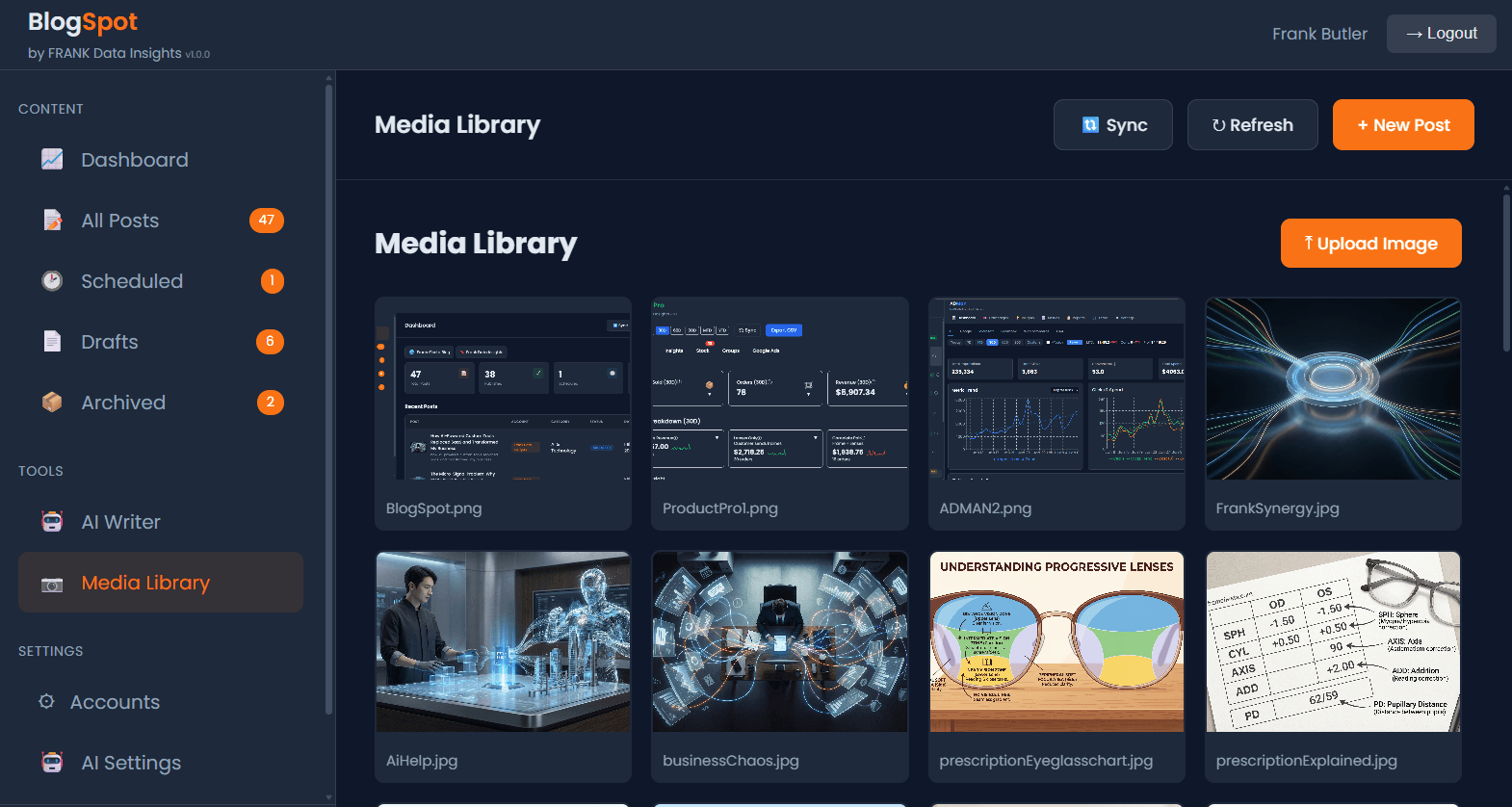
The media library includes AI-powered image analysis and tagging, an approval workflow for team collaboration, and hot folder processing that turns our content production workflow from a multi-tool juggling act into a streamlined pipeline.
**Cost savings:** $200-$400/month, plus social media decisions informed by actual business data instead of vanity metrics.
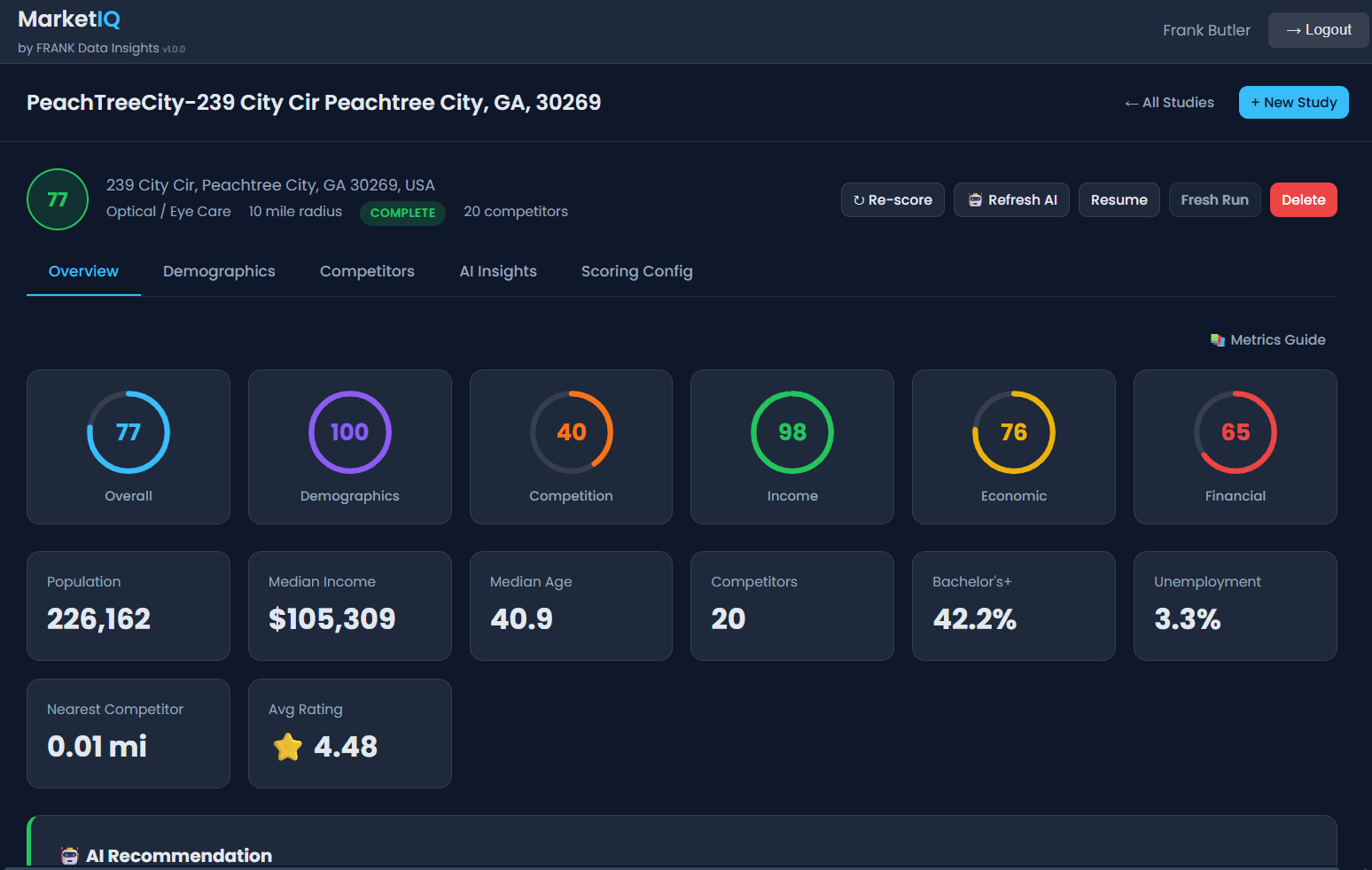
The Market changes - Your Market IQ needs to grow as well
Market IQ: Competitive Intelligence on Our Terms
**What it's replacing:** Competitive analysis tools like SEMrush, SimilarWeb, or Crayon. Monthly cost: $200-$500.
**What we're building:** A competitive intelligence layer that monitors competitor pricing, positioning, and market movements, then contextualizes that data against our own performance metrics.
Market IQ represents the next frontier of what becomes possible when you own your stack. Instead of a generic competitive dashboard that treats every business the same, we're building intelligence that understands our specific competitive landscape—our products, our margins, our geographic markets.
When a competitor drops their price on a product we both carry, Market IQ won't just alert us to the change. It will show us our current margin on that product, our advertising efficiency for it, and how much room we have to respond—if responding is even the right move. Sometimes the data says to let the competitor have the race to the bottom while we invest in the products where we have a genuine advantage.
**Projected cost savings:** $200-$500/month, plus competitive decisions based on our actual business economics, not generic market data.
---
The Real Math: What SaaS Dependency Actually Costs
Let me lay out the numbers honestly.
**Monthly SaaS spend we've eliminated or are in the process of eliminating:**
| Category | SaaS Cost | FRANK Module | Status |
|----------|-----------|--------------|--------|
| Ad reporting & analytics | $300-$600/mo | ADMan | Production |
| Product analytics & BI | $200-$500/mo | ProductPro | Production |
| Content management | $100-$200/mo | BlogSpot | Production |
| Social media management | $200-$400/mo | BuzzHub | In Development |
| Feed management | $100-$300/mo | MCSync | Production |
| Competitive intelligence | $200-$500/mo | Market IQ | Planned |
| BI aggregation layer | $300-$800/mo | FRANK Intelligence | Planned |
| **Total** | **$1,400-$3,300/mo** | | |
That's $16,800 to $39,600 per year in subscription fees. For a small business, that's a part-time employee. That's a marketing budget. That's the difference between reinvesting in growth and treading water.
But the subscription cost is only half the story.
The real cost of SaaS dependency is the tax on your decision-making. It's the hours spent logging into seven different dashboards every morning. It's the insights that live in the gaps between tools that you never discover. It's the custom report you need but can't build because the tool doesn't support it. It's the integration that breaks every time one vendor updates their API.
We estimated that our team was spending 8-12 hours per week on what I call "tool arbitrage"—pulling data from one platform, transforming it in a spreadsheet, comparing it against data from another platform, and trying to reconcile the discrepancies. At consulting rates, that's another $20,000-$30,000 per year in lost productivity.
When you add the subscription costs, the productivity tax, and the opportunity cost of insights never discovered, SaaS dependency was costing us roughly $50,000-$70,000 per year.
FRANK, running on a Raspberry Pi connected to a NAS, costs us essentially nothing to operate. The hardware was a one-time investment under $500. The development cost was time—our time, amplified by AI.
---

Why This Wasn't Possible Three Years Ago
I want to be clear about something: I'm not anti-SaaS. Three years ago, SaaS was the right choice for most SMBs. Building custom tools required hiring developers at $150,000+ per year, managing a development team, handling infrastructure, and maintaining code over time. The economics didn't work.
What changed is AI.
Specifically, what changed is the ability to use AI as a co-builder—not a code generator, not an autocomplete engine, but a genuine collaborator that can help you architect, implement, debug, and refine production-grade software.
Every module I described above was built collaboratively with Claude. The process looks like this: I bring the business problem and domain expertise. Claude brings the technical architecture and implementation capability. We have a conversation. We iterate. We build.
The data normalization engine in ADMan—the system that reconciles metrics across five advertising platforms with different attribution models, date formats, and naming conventions—would have been a $30,000-$50,000 custom development project in 2023. We built it in a series of late-night sessions over three weeks.
ProductPro's health scoring algorithm—the system that weights 15 different metrics to produce a single actionable score for every product—would have required a data scientist. We designed and implemented it in collaborative dialogue, testing and refining the weightings against real business outcomes.
BlogSpot's multi-platform publishing system, BuzzHub's content pipeline, MCSync's automated feed management—each one would have been a significant development effort requiring specialized expertise.
With AI as a co-builder, the bottleneck shifted from "can we build this?" to "should we build this?" And that's a much better question to be asking.
---
The Customization Advantage No SaaS Can Match
Here's the thing that SaaS defenders always miss when they argue that subscription tools are "good enough."
Good enough for what?
Good enough for the average business in your category. Good enough for the generic use case. Good enough for the 80% of features that 80% of users need.
But your business isn't average. Your questions aren't generic. And the 20% of functionality that matters most to you is exactly the 20% that no SaaS tool will ever prioritize, because it doesn't serve their broad enough customer base.
Let me give you a specific example.
In our business, we discovered that certain products had what we called a "halo effect"—customers who purchased Product A were significantly more likely to return within 30 days and purchase higher-margin Products B and C. Product A itself had thin margins and mediocre standalone metrics. Any SaaS analytics tool would have flagged it as underperforming.
But when we built ProductPro, we could add a "customer journey contribution" metric that accounted for this halo effect. Suddenly, Product A went from "consider discontinuing" to "protect at all costs—it's our best customer acquisition tool."
Try requesting that feature from your SaaS provider. I'll wait.
This is the customization advantage of owning your stack. When you discover something unique about your business—and every business has unique dynamics if you look closely enough—you can build for it. Immediately. Not "submit a feature request and hope." Not "hack together a workaround with Zapier." Build the actual solution, tailored to your actual business, deployed on your actual timeline.
We've done this dozens of times. A custom attribution model that accounts for our specific customer journey. A stock reorder calculator that factors in our actual supplier lead times and seasonal patterns. A content performance metric that weights engagement by customer lifetime value instead of raw pageviews. An advertising cannibalization detector that understands our specific product relationships.
Each of these is a small thing. But compounded over time, across every tool and every decision, they represent a fundamentally different quality of business intelligence than what any off-the-shelf solution can provide.
---
The Infrastructure Reality: It's Simpler Than You Think
One of the biggest objections I hear is: "Custom tools sound great, but I don't want to manage infrastructure."
Fair. But let me tell you what our infrastructure actually looks like.

FRANK runs on a Raspberry Pi. Not a cluster of cloud servers. Not a Kubernetes deployment. A $75 single-board computer sitting on a shelf in my office, connected to a NAS that was already there for file storage.
The backend is Python with FastAPI—a modern, well-documented framework that AI can help you work with extremely effectively. The database is PostgreSQL running on the NAS. The frontend modules use React. Everything is deployed with systemd services and served through nginx.
Total infrastructure cost: roughly $200 in hardware, one-time. Monthly operating cost: the electricity to run a device that draws about 5 watts.
Compare that to the cloud infrastructure a SaaS company charges you to subsidize. When you're paying $400/month for a social media tool, a significant portion of that fee is covering their AWS bill, their engineering team, their sales staff, their office lease, and their investors' expected returns.
You're paying for their business to exist. With your own stack, you're only paying for the actual compute and storage you use—which, for an SMB, is negligible.
Now, I'm not suggesting this approach works for every business or every scale. If you're running a 500-person company with complex compliance requirements, self-hosted tools carry different trade-offs. But for the vast majority of SMBs—businesses with 5 to 50 employees doing $1 million to $50 million in revenue—the infrastructure requirements are well within reach.
---
The Development Roadmap: What's Coming Next
One of the most powerful aspects of owning your stack is controlling your roadmap. We don't wait for a vendor to decide our features are worth building. We build what we need, when we need it.
Here's what's actively in development and planned:
**FRANK Intelligence** — the AI-powered insights layer that ties all modules together. This is the capstone of the entire system. Instead of looking at advertising data in ADMan and product data in ProductPro separately, FRANK Intelligence will surface cross-module insights automatically. "Your top-performing ad campaign is driving traffic to a product that ProductPro flagged as a Silent Killer—high returns, low margin. Consider redirecting spend to these three Hidden Gems instead."
A Company Health Score from 0 to 100, calculated from weighted inputs across every module. Daily executive briefings delivered by email that tell you the three most important things to focus on today. Predictive alerts that warn you before metrics decline, not after.
**BlogSpot-Beta** — an AI-powered content engine that generates topic suggestions based on what's actually driving traffic and conversions, not just keyword volume. Content performance scoring that connects blog engagement to downstream revenue.
**BuzzHub Full Launch** — completing the social media management suite with AI-powered caption generation informed by conversion data, automated posting workflows, and engagement analytics weighted by business impact.
**Market IQ** — competitive intelligence that understands our specific market position and business economics, not generic industry benchmarks.
**TaskPro** — internal project management built around how we actually work, with AI-assisted task prioritization based on business impact rather than arbitrary deadlines.
Every one of these features is informed by the real patterns we've observed in our data. We're not building features because a product manager at a SaaS company thinks they'll drive upgrades. We're building features because our data told us we needed them.
---
Is a custom build right for you?
---
References
BetterCloud — State of SaaSOps Report (2024–2025) BetterCloud reports that the average organization now uses 40+ SaaS applications, with continued growth in SaaS spend, redundancy, and operational complexity across SMBs and mid-market companies. https://www.bettercloud.com/resources/state-of-saas/
Blissfully (acquired by Vendr) — SaaS Trends Report Blissfully found that small and mid-sized businesses typically use 30–50 SaaS tools, with significant overlap and underutilization driving unnecessary cost and workflow fragmentation. https://www.vendr.com/blog/saas-statistics
Gartner — Forecast: Public Cloud Services Worldwide Gartner highlights sustained growth in SaaS spending and notes that subscription software costs are increasingly driven by tiered pricing, usage-based expansion, and vendor lock-in strategies rather than incremental utility. https://www.gartner.com/en/information-technology/insights/cloud-strategy
Zylo — SaaS Management & Spend Insights Zylo reports that over 95% of businesses rely on SaaS, with many organizations now actively pursuing SaaS consolidation due to rising costs and diminishing marginal returns from additional tools. https://zylo.com/blog/saas-statistics/
Vendr — SaaS Spend Growth & Optimization Trends Vendr’s analysis shows SaaS spending for SMBs has increased sharply since 2022, while ROI and actual tool utilization have lagged behind cost growth—fueling consolidation and replacement initiatives. https://www.vendr.com/blog/saas-spend-management
McKinsey & Company — The Next Horizon of Software Economics McKinsey outlines how AI and automation are shifting the build-vs-buy calculus, enabling smaller organizations to replace generic SaaS tools with custom internal systems at dramatically lower cost than in prior years. https://www.mckinsey.com/capabilities/mckinsey-digital/our-insights/software-development-in-the-age-of-ai
About the Author

Related Articles

What we built this week - with Ai p4
Is your business being served by Ai agents?

Can ChatGPT Find Your Business? We Built a Free Tool to Find Out.
We built the Frank Business Diagnostic, a free scanner that looks at your business from the perspective of AI and search technology and identifies areas that may be limiting your visibility.
