
Market IQ, a star is born!
After a strong Q1, we started asking the next obvious question.
If our e-commerce business is working online, what would it take to work offline too?
A physical location is a very different animal. Online, if you pick the wrong keyword or the wrong platform, you adjust and move on. Offline, if you pick the wrong block, you're locked into a lease, a buildout, and a set of monthly obligations that don’t care how the store is doing.
So before we signed anything, I wanted the same thing we’ve built for every other part of the business.
A system that turns a gut call into a data-backed decision.
That’s why I built MarketIQ inside FRANK.
This blog walks through how we’re using it to find our next location — without giving away where we’re looking or what brand is behind it. We haven’t landed on a property yet. But the data is already telling us where to look, and just as importantly, where not to.
The Three Questions Every Location Has to Answer
When you strip retail expansion down to its core, it really comes down to three questions.
That sounds simple. But answering those three questions well requires pulling together data from multiple perspectives — local population characteristics, competitive presence, economic stability, and your own financial model.
Most people try to do this with a spreadsheet and a few searches. I tried that too. It’s not workable at scale, and more importantly, it’s not consistent. Every location you evaluate gets a slightly different level of rigor, and you end up making apples-to-oranges comparisons.
MarketIQ was built to fix that.
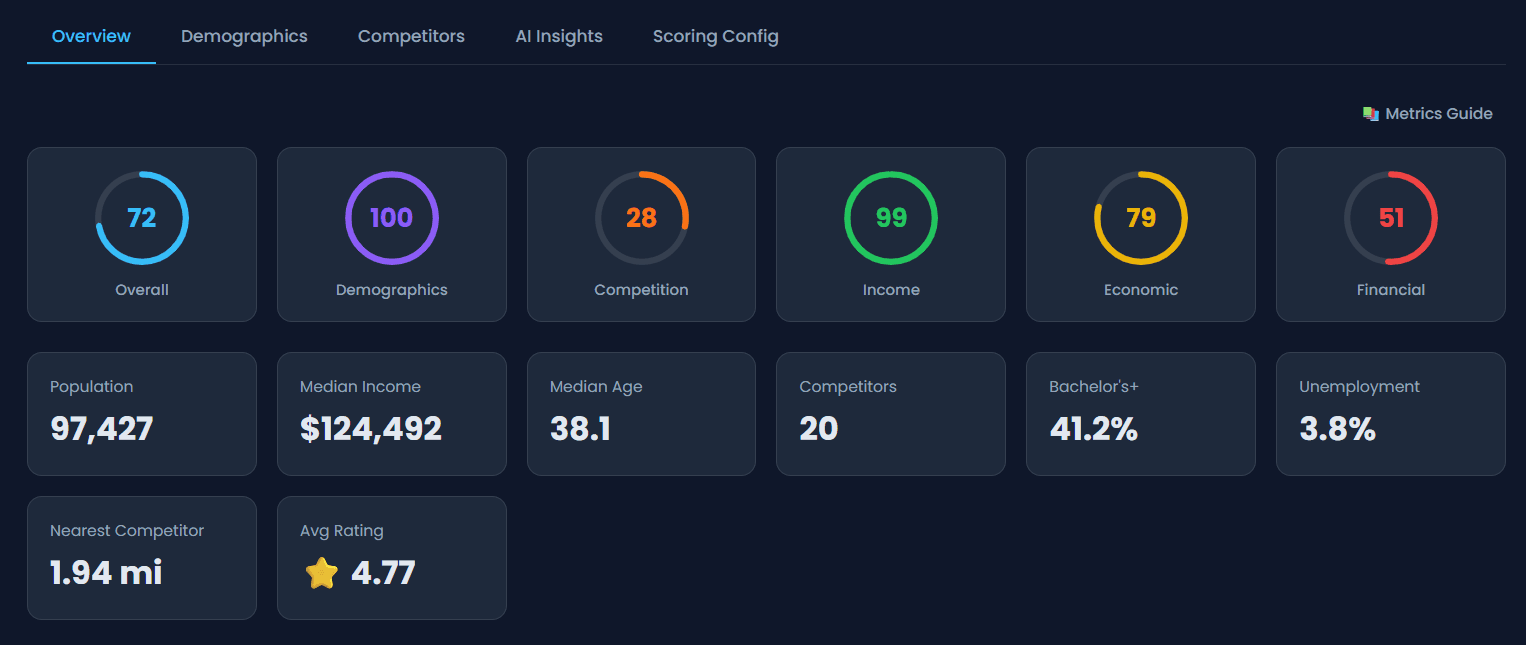
You drop in an address and a radius. The system builds a full market picture, applies a scoring model, and produces a single, comparable result.
Then — and this is the part that matters most — you adjust.
How the Numbers Are Derived
MarketIQ blends multiple categories of data so that no single signal dominates the picture.
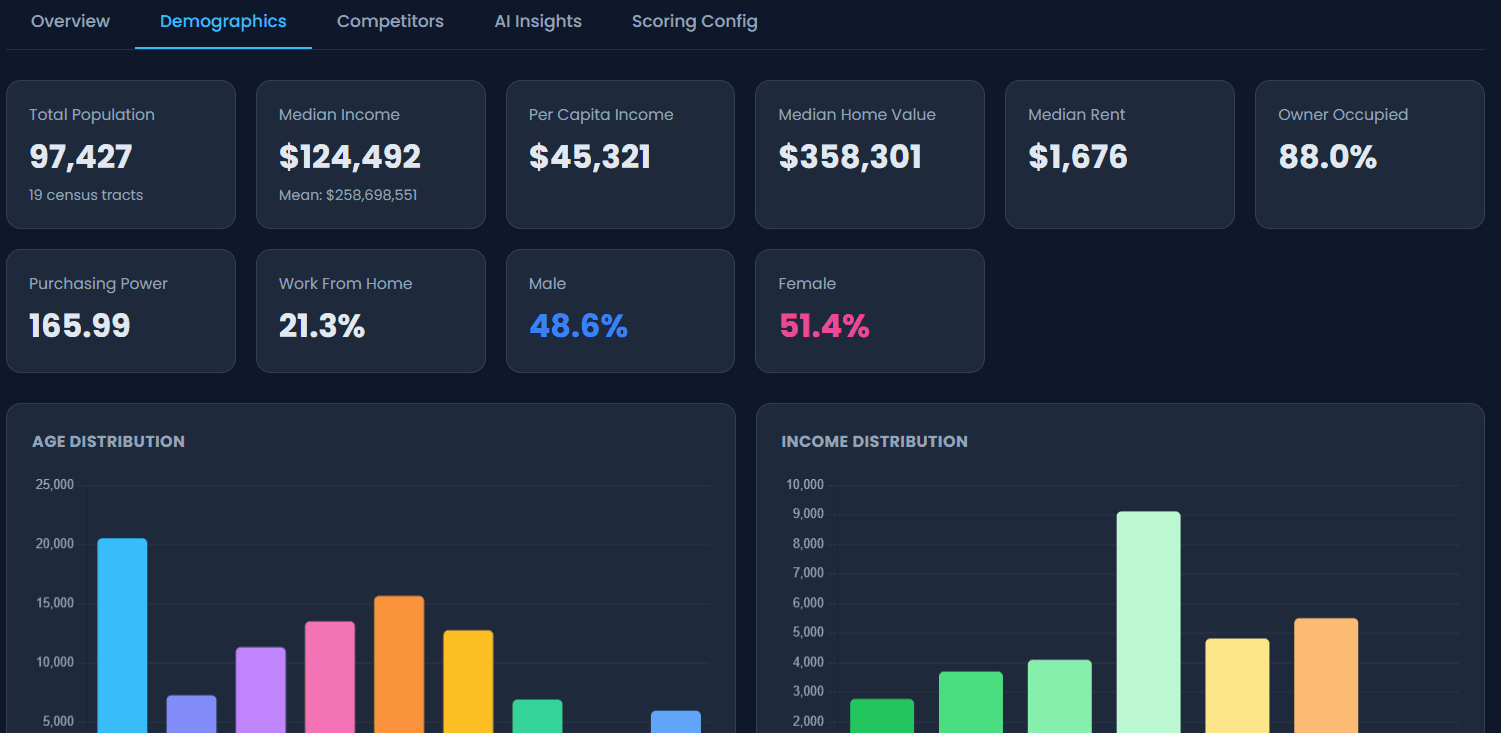
We look at population characteristics like age distribution, household makeup, education, and lifestyle indicators — not just totals, but how well those align with your actual customer.
We analyze the competitive environment — not just who exists, but how many there are, how close they are, how strong they appear, and where there may be gaps.
We factor in broader economic conditions — stability, activity levels, and indicators that suggest whether a market can sustain ongoing business activity.
And then there’s the part most tools ignore.
Financial viability — your numbers.
You tell the system what your business actually looks like:
This is where the system stops being generic and starts being real.
Because a market isn’t “good” or “bad” on its own. It’s only good or bad relative to whether your business can survive and grow there.
MarketIQ rolls all of this into five category scores on a 0 to 100 scale:
And a weighted overall score on top of that.
The Part That Makes It Yours
Here’s where most location tools fall apart.
They give you one number and call it a day. A 78 is a 78 regardless of what business you’re running.
That’s not how real decisions work.
The ideal location for a fitness studio is not the ideal location for an optical shop, which is not the ideal location for a restaurant. The customer is different. The cost structure is different. The risk tolerance is different.
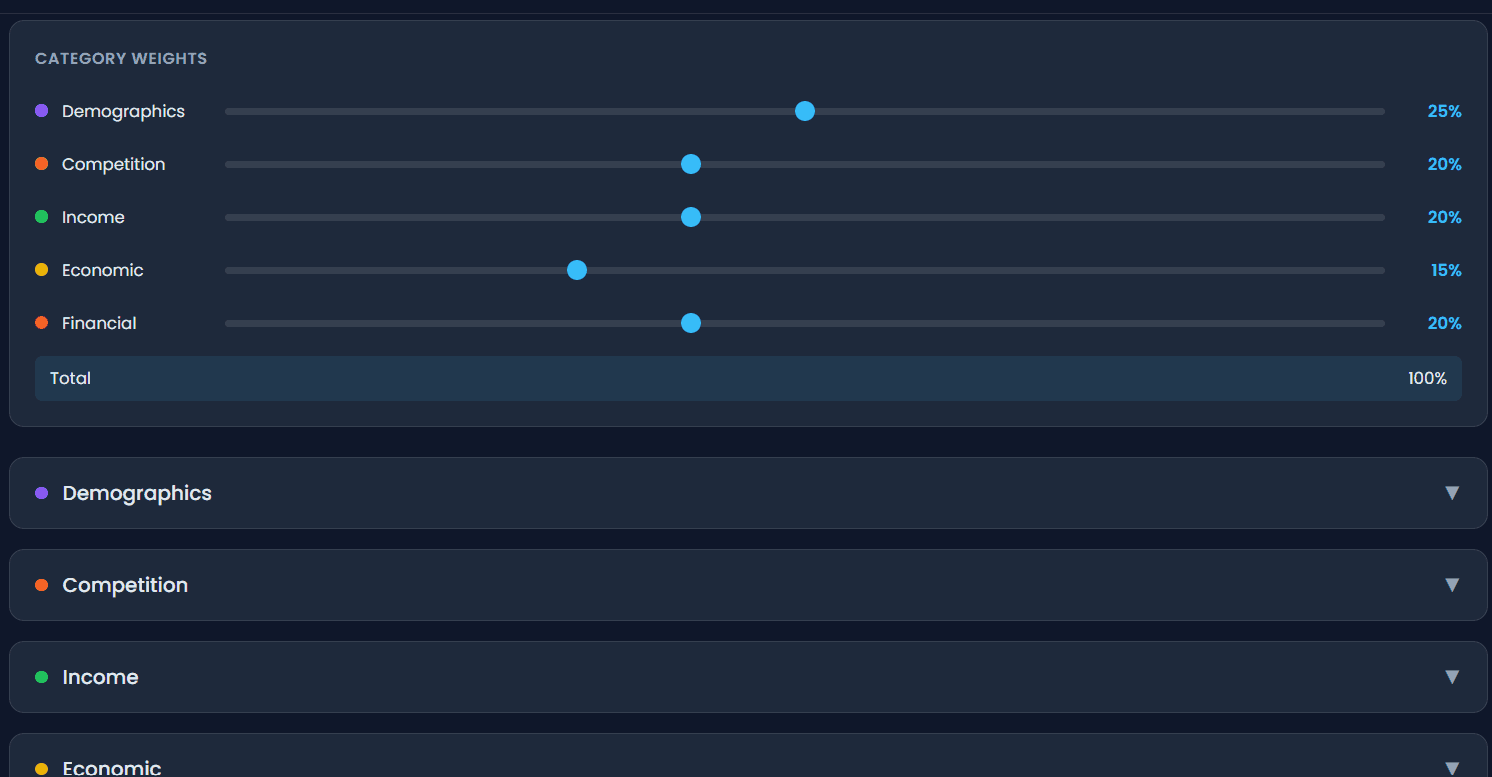
So MarketIQ lets you adjust every weight, on the fly, without re-pulling any data.
The default category mix is:
For our expansion, that’s not the right mix.
Our customer skews a bit older, with higher household income, and we care a lot about what’s already on the street near us. So I adjusted the weights accordingly — pushing Demographics and Income higher, pulling Economic down slightly, and keeping Financial where it matters.
I save that as a profile, apply it to every location I’m evaluating, and now I’m comparing apples to apples.
You can go even deeper.
Inside each category are sub-weights you can tune — age vs population, saturation vs sentiment, purchasing power vs distribution. You define what matters, and the system reflects it instantly.
No second data pull. No waiting. Just a recalculated view based on your priorities.
How the Scoring Actually Works
A quick example, because weights don’t mean much without context.
Take Income.
It’s not just one number. It’s a combination of:
Those roll into a single category score based on the weights you set.
Competition works differently.
The curve isn’t linear — it’s balanced.
No competitors doesn’t score high, because demand isn’t validated. A few competitors is ideal. Too many, and you’re walking into saturation.
That mirrors reality.
An empty market is a question mark. A crowded market is a warning sign. The middle is where opportunity usually lives.
Financial Viability is where the system gets honest.
It doesn’t care how attractive a location looks.
It looks at your total monthly burn — not just rent, but everything:
Then it compares that to what the market can realistically support.
It estimates how long it would take to break even and whether your cost structure makes sense for that environment.
That number alone has changed how we think about certain locations.
What the Data Has Told Us So Far
We’ve run a handful of candidate markets through MarketIQ over the past few weeks. I’m not going to share cities or numbers, but I’ll tell you the pattern.
The markets that felt like obvious wins — high traffic, visible retail corridors — weren’t always the ones that scored best.
Some had strong demographics but too much competition.
Some looked great on paper but didn’t align with purchasing power.
Some felt average but scored well once we adjusted for our actual customer and cost structure.
The side-by-side comparison view is where this becomes real.
Put a few markets next to each other, apply the same weights, and the tradeoffs are obvious in seconds.
One wins on demographics. Another on cost structure. Another on competitive positioning.
The system shows you why — and lets you challenge it.
We haven’t picked a location yet. That’s intentional.
The goal isn’t to have the system decide for us.
The goal is to narrow the field, expose the tradeoffs, and make sure that when we do commit, we understand exactly what we’re stepping into.
Where It’s Heading
Right now, MarketIQ handles the macro decision — which market.
The next layer is the micro decision — which block.
Foot traffic patterns. Visibility. Parking. Nearby businesses. How people actually move through the area.
Because picking the right city is one decision.
Picking the right spot inside that city is another.
And both are too expensive to get wrong.
The Bigger Point
The lesson from online was simple.
Most platforms are designed to help you spend money — not necessarily to spend it well.
That responsibility is yours.
Offline is no different.
Every broker, every landlord, every listing will tell you why their location works.
That’s their job.
Your job is to have your own source of truth.
One that understands your customer.
Your costs.
Your risk tolerance.
One that gives you consistent, comparable answers across every option you look at.
MarketIQ is ours.
And when we finally sign a lease, it won’t be because something “felt right.”
It’ll be because the numbers said we could make it work.
Stay tuned.
About the Author

Related Articles

What we built this week - with Ai p4
Is your business being served by Ai agents?

Can ChatGPT Find Your Business? We Built a Free Tool to Find Out.
We built the Frank Business Diagnostic, a free scanner that looks at your business from the perspective of AI and search technology and identifies areas that may be limiting your visibility.
