
I have a warm place for HBCUs in my heart.
I spent the first two years of my college career at Fayetteville State University on a football scholarship, and my final two years completing my undergraduate degree at East Carolina University, a predominantly white institution.
Both experiences were equally important to my career growth and my growth as a man.
My time at Fayetteville State was formative in ways that are difficult to explain unless you have experienced an HBCU campus firsthand. There was a sense of belonging that went beyond the classroom. Professors pushed students not just to succeed academically, but to understand the broader responsibility of becoming a leader in my community.
It was a place where people believed in your potential before you fully saw it yourself.
Later, when I transferred to East Carolina University, I experienced something completely different.
I remember my first time walking on the mall at ECU my first day of classes and seeing thousands of students walking toward me from the other end of the mall.
It felt like an ocean of people.
Students everywhere, all heading in different directions, all carrying books, backpacks, conversations, and ambition.
In that moment something hit me.
The scale.
At Fayetteville State, the environment was personal and tight-knit. At ECU, I suddenly realized I was standing in the middle of a much larger system. Thousands of students, all competing for the same opportunities, the same internships, the same recognition.
I remember thinking to myself: this is a different level of competition.
It wasn’t intimidating.
It was clarifying.
It forced me to understand that the world I was preparing to enter was larger than any one campus, and that success would require navigating environments that were both familiar and unfamiliar.
Years later, when I returned to school to complete my MBA at GMU, I realized I was entering a third stage of growth. Fayetteville State had taught me identity and confidence. East Carolina had shown me the scale of the world I was stepping into. My time at George Mason pushed me toward something different — execution. It was where I began to understand what it actually takes to deliver in business: strategy, accountability, and the discipline required to turn ideas into results. And the truth is, those lessons only made sense because of what I had already learned at Fayetteville State and East Carolina.
Each stage of my academic journey taught me something different.
Fayetteville State taught me confidence and a larger reason for focus.
East Carolina taught me competing at scale.
George Mason taught me how to pull it all together.
Which is why when the Supreme Court ruled that race could no longer be considered in college admissions, I didn’t just see controversy.
I saw responsibility.
And equally important, I saw opportunity.
When you remove the emotion attached to a change in law and examine the broader system of higher education, a new reality becomes visible.
A gap is forming.
And historically Black colleges and universities may now be uniquely positioned to fill it.
A Shift in the Landscape of Higher Education
In 2023, the United States Supreme Court ruled that race could no longer be used as a factor in university admissions.
The ruling fundamentally reshaped admissions policy across the country.
Universities can still consider life experiences, socioeconomic background, and personal essays, but race itself can no longer be directly considered in admissions decisions.
The long-term effects will take years to fully measure, but the early data is already telling an interesting story.
At several highly selective universities, the share of Black freshmen declined following the ruling.
Studies analyzing selective institutions have found declines in Black freshman enrollment at many elite universities in the first admissions cycle after the decision. Some institutions saw declines of more than 30 percent in the share of Black students within their incoming class.
These numbers do not tell the full story yet, but they reveal something important.
When admissions policies change at the top of the academic ladder, the effects ripple throughout the entire higher education system.
Researchers refer to this phenomenon as the cascade effect.
Students who might have previously attended the most selective institutions enroll at other universities instead, shifting the distribution of talent across the entire system.
And that is where HBCUs may find themselves standing at a unique crossroads.
The Growing Importance of HBCUs
Historically Black Colleges and Universities have always played a special role in American higher education.
There are roughly 100 HBCUs in the United States, representing only a small fraction of the country’s colleges and universities.
Yet their impact has always been disproportionate.
HBCUs educate roughly 300,000 to 375,000 students nationwide, and they enroll approximately 9 percent of all Black college students in the United States.
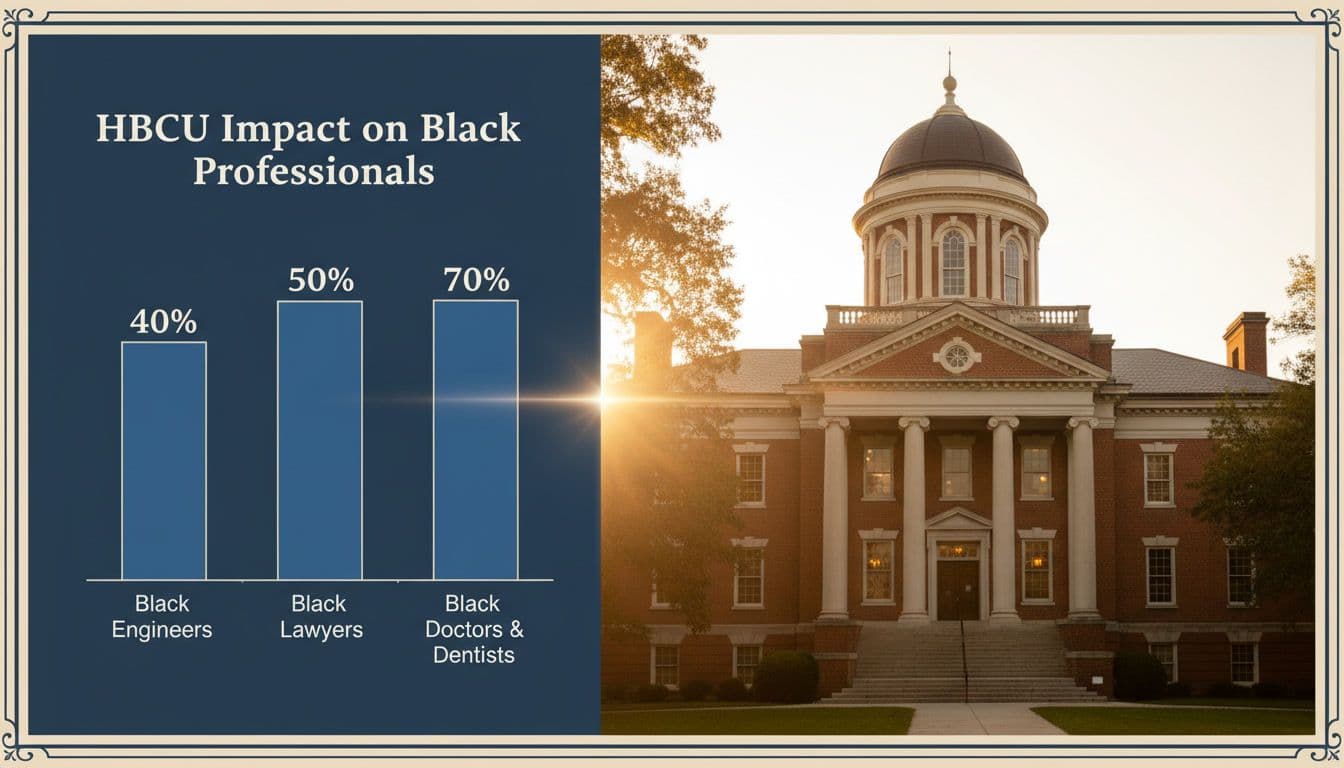
Despite representing a small portion of institutions, HBCUs produce an outsized share of Black professionals.
Historically they have produced:
• roughly 40 percent of Black engineers • nearly 50 percent of Black lawyers • around 70 percent of Black doctors and dentists
Their impact on the Black professional class cannot be overstated.
And now demand for these institutions is increasing.
Over the past several years, many HBCUs have reported record numbers of applications.
Enrollment across HBCUs has also grown in recent years.
Approximate enrollment numbers across HBCUs show a steady upward trend:
2020 — approximately 279,000 students
2021 — approximately 294,000 students
2022 — approximately 343,000 students
2023 — approximately 354,000 students
2024 — estimated 375,000 students
The trend is clear.
Interest in HBCUs is rising.
And the Supreme Court ruling may accelerate that trend even further.
A Prediction: HBCUs Will Become Harder to Get Into
If these trends continue, the most competitive HBCUs will become significantly harder to get into.
This is both a positive and a challenge.
On one hand, increased competition often raises the academic profile of an institution.
On the other hand, increased selectivity means fewer students ultimately gain access.
But the answer for top-tier HBCUs should not simply be expanding enrollment.
In fact, the opposite may be true.
The Top HBCUs Should Raise the Bar
As application pools grow, the leading HBCUs should focus on increasing academic standards rather than dramatically increasing class sizes.
The institutions already positioned at the top academically include:
Howard University
Spelman College
Morehouse College
North Carolina A&T State University
Florida A&M University
These schools should lean into their growing influence.
Instead of attempting to absorb dramatically larger student populations, they should focus on strengthening their role as elite academic incubators.
That means:
• Raising admissions standards
• Expanding research capabilities
• Recruiting world-class faculty
• Building stronger partnerships with industry
• Auditing internal processes to ensure students are receiving the highest-quality education possible
This approach would position top HBCUs as globally competitive institutions capable of producing leaders in science, technology, business, and policy.
The AI Economy Is Changing the Value of a Degree
At the same time that admissions policies are shifting, another transformation is happening.
Artificial intelligence is reshaping the global labor market.
For decades, a bachelor’s degree was considered the entry ticket to the professional class.
But automation is changing the nature of entry-level work.
A report from Goldman Sachs estimates that AI could automate tasks equivalent to 300 million full-time jobs globally.
Meanwhile, research from McKinsey suggests that up to 30 percent of work hours in the U.S. economy could be automated by 2030.
These shifts are particularly important for college graduates.
Many of the jobs traditionally filled by recent graduates — research assistants, analysts, junior programmers, entry-level consultants — are among those most vulnerable to automation.
This does not mean higher education is becoming irrelevant.
But it does mean universities must evolve.
Universities Must Adapt to a New Knowledge Economy
If automation replaces many traditional entry-level roles, universities must shift their focus.
Higher education can no longer rely solely on traditional lecture-based models of knowledge transfer.
Instead, institutions must prioritize:
• problem-solving
• interdisciplinary thinking
• entrepreneurship
• leadership development
• creative innovation
Graduates will increasingly need to create value rather than simply execute routine tasks.
This shift presents an opportunity for institutions willing to rethink how education is delivered.
HBCUs, with their historically strong mentorship culture and tight-knit communities, may be uniquely positioned to adapt quickly.
The Responsibility HBCUs Now Carry
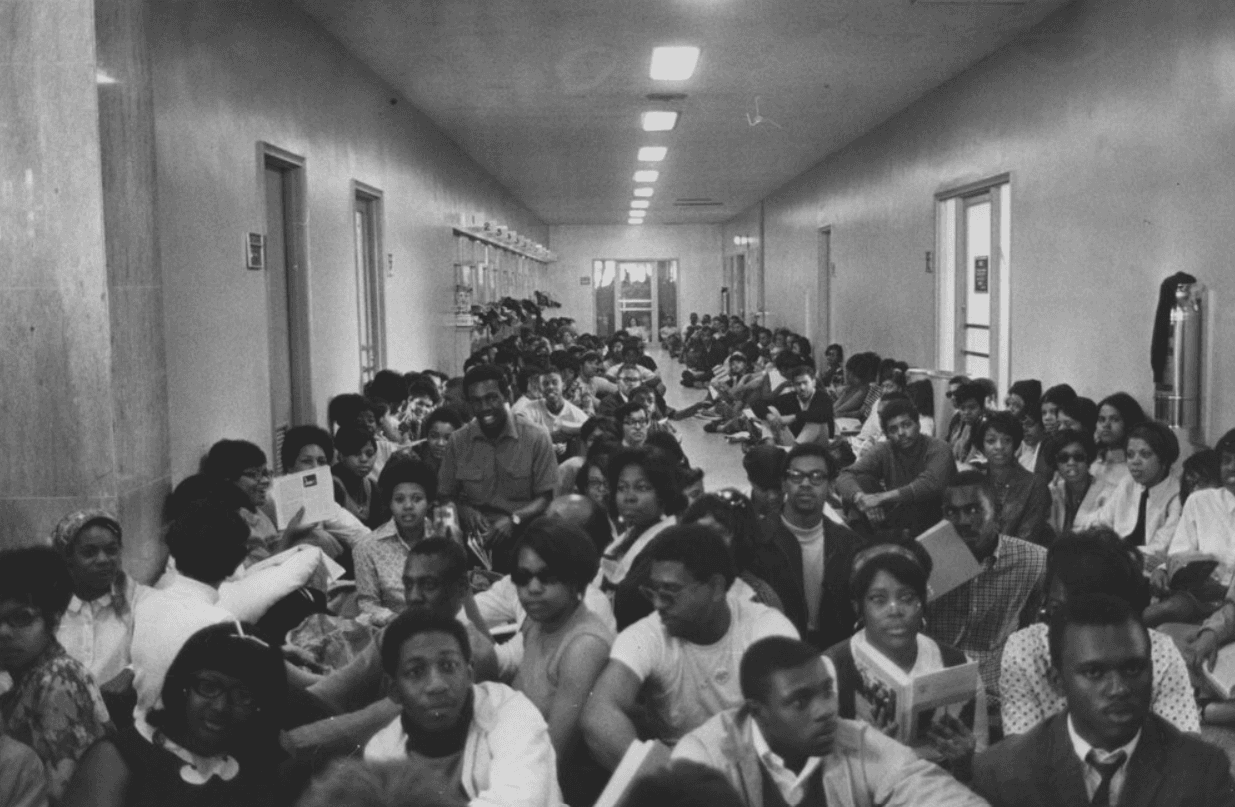
Students occupy Howard University’s administration building during protests demanding a “Black University,” March 1968.
Photo courtesy of DC Public Library Special Collections, via the DC1968 Project.
HBCUs were originally created because Black Americans were excluded from most universities.
They were institutions born from necessity.
They provided opportunity during a time when opportunity was denied elsewhere.
Today, they may once again find themselves at the center of a pivotal moment.
If Black representation declines at some elite universities, HBCUs may become even more central to the development of Black intellectual and professional leadership.
That responsibility is significant.
It means preparing students not only to graduate but to compete globally.
In technology.
In finance.
In entrepreneurship.
In artificial intelligence.
In science.
In policy.
In leadership.
A Defining Moment for HBCUs
The end of race-conscious admissions is not simply a legal change.
It is a structural shift in higher education.
Moments like this rarely come without controversy.
But they also rarely come without opportunity.
Historically Black Colleges and Universities now face an important question.
Will they simply absorb students redirected by admissions changes?
Or will they rise to become the next intellectual engines of Black excellence in America?
The opportunity is real.
But so is the responsibility.
And if history is any guide, HBCUs have always risen to meet moments like this.
The opportunity is now.
References & Further Reading
- Supreme Court ruling overview
- Harvard admissions data
- Reduction in Black Freshmen at select colleges
- National Center for Education Statistics HBCU data
- United Negro College Fund HBCU impact
- Goldman Sachs AI labor impact
- McKinsey future of work automation study
- Howard Admission Article
- Spellman Admissions Article
About the Author
Related Articles

What we built this week - with Ai p4
Is your business being served by Ai agents?

Can ChatGPT Find Your Business? We Built a Free Tool to Find Out.
We built the Frank Business Diagnostic, a free scanner that looks at your business from the perspective of AI and search technology and identifies areas that may be limiting your visibility.
