
A Measured, Personal Response to The 2028 Global Intelligence Crisis
(Part 1 of 3)
Introduction: Why This Thought Experiment Stuck With Me
When The 2028 Global Intelligence Crisis started circulating, I didn’t read it as a warning from the outside. I read it as someone already inside the system it was describing.
The essay, published by Citrini Research, is framed as a thought experiment written from the future — a worst-case look back at how artificial intelligence reshaped labor, consumption, and markets. It’s not presented as a prediction, but it doesn’t read like science fiction either.
What made it resonate for me is simple: many of the ideas feel logical.
AI is advancing quickly.
White-collar work is being compressed.
Productivity is becoming less dependent on headcount.
I work in tech. I’ve spent years using, supporting, analyzing, and optimizing systems — the exact kind of work that’s often described as “safe” until it suddenly isn’t. I don’t feel panic reading articles like this, but I do feel awareness. The sense that traditional career paths are changing, and that adapting early is better than reacting late.
The Citrini essay asks: What if AI’s success becomes an economic risk?
As I sat with it, I kept asking something slightly different:
What if the same forces creating disruption are also creating an opening?

Will AI Replace White-Collar Jobs? I Think So — and I’ve Made Peace With That
I don’t argue this point anymore.
Yes, AI will replace white-collar jobs.
Yes, many of those jobs will not return.
I’ve watched tasks shrink that once justified entire roles. I’ve seen work that used to require coordination, documentation, and review become faster, simpler, and more automated. This isn’t theoretical — it’s incremental and already happening.
When you’re in tech, you don’t need a headline to feel the shift. You see it in how teams are structured, how budgets are allocated, and how often “efficiency” comes up as both a goal and a justification.
That awareness doesn’t make me defensive. It makes me curious.
Because once you accept that roles can disappear, you start thinking less about protecting a job and more about preserving relevance.
What I’ve Realized: Roles Are Fragile, Capability Isn’t
One thing that stood out to me as I reflected on the essay is how much white-collar work over the last two decades has revolved around managing friction.
I’ve spent time translating ideas into tickets.
Tickets into sprints.
Sprints into releases.
At some point, you realize that a lot of modern work exists not because the value itself is complex, but because the systems around it are.
AI is very good at removing that friction.
So instead of asking myself, What happens if my role disappears? I’ve started asking:
What happens to my skills when the friction that made my role necessary is gone?
That question leads somewhere more constructive.
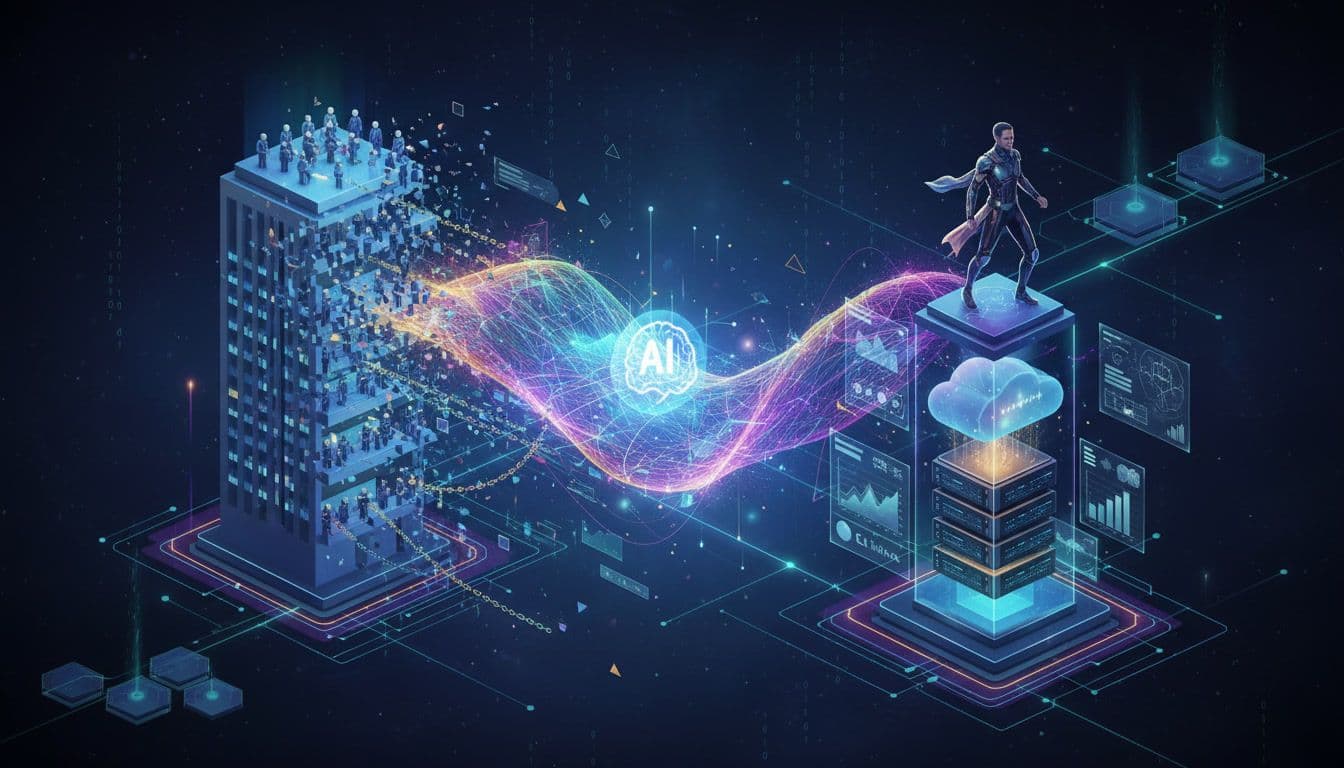
I’ve Felt the Shift From Optimization to Ownership
The change hasn’t been dramatic for me. It’s been subtle.
I find myself building systems independently — not because anyone asked me to, but because I can. Automating workflows that once required manual oversight. Turning insights into something reusable instead of one-off.
Not as a rebellion against corporate work — but as an exploration of what’s possible now.
AI has lowered the cost of execution so much that it’s hard not to experiment. When building becomes easier, the question naturally shifts from “Can I?” to “Why wouldn’t I?”
That’s where the crisis narrative starts to feel incomplete.
What If This Is a Reallocation, Not a Collapse?
The 2028 Global Intelligence Crisis outlines a serious macro concern: if white-collar income declines, consumer spending drops, and because consumption drives a large portion of GDP, the economy contracts.
That logic makes sense.
But it assumes that income generation remains centralized — tied primarily to employment within large organizations.
What I’m increasingly seeing, and participating in, suggests something else may be forming underneath that assumption.
What if AI allows more people to create value independently?
What if income doesn’t disappear — it fragments?
What if economic participation becomes more distributed?
In that scenario, corporate profits may shrink — but opportunity widens.
That’s not collapse. That’s rebalancing.
From Employee to Operator — Sometimes Without Intending To
One thing AI has changed for me personally is how I think about scale.
What used to require teams now requires systems.
What used to require coordination now requires clarity.
What used to take weeks now takes hours.
That changes the minimum viable size of a business.
It’s no longer unrealistic for one person — or a very small team — to deliver complete solutions directly to customers. Not as a freelancer filling gaps, but as an operator owning the full loop.
AI doesn’t just replace labor.
It removes layers.
And when layers disappear, ownership becomes accessible.
How Abundant Intelligence Actually Feels Day-to-Day
The essay frames abundant intelligence as destabilizing — intelligence becoming so cheap that it undermines economic norms.
From my perspective, it feels more like acceleration than erosion.
I spend less time assembling data and more time understanding it.
I spend less time formatting insights and more time exploring scenarios.
I’m no longer constrained by how tools expect me to ask questions.
And one of the most important shifts: if data isn’t presented in a way that answers the question I’m asking, I can change the presentation immediately.
No sprint.
No backlog.
No translation loss.
That’s not automation.
That’s leverage.
Why I See Abundant Intelligence Fueling a DTC Shift
When I zoom out, abundant intelligence looks like an accelerant for something that was already underway: a broader move toward direct-to-consumer value creation.
Not just in retail — but in software, analytics, services, and expertise.
AI allows individuals to:
Big companies are optimized for efficiency at scale.
Individuals are optimized for speed, focus, and specificity.
As execution costs fall, that advantage compounds.
Where I Think the Real Risk Lives
I don’t think the biggest risk is that AI replaces white-collar jobs.
I think the real risk is cultural and structural: continuing to treat employment as the primary — or only — way to participate in the economy.
If policy, capital, and education lag behind this shift, disruption can feel like instability.
But if we recognize what’s happening — early enough — a different outcome becomes possible:
More owners.
More small operators.
More distributed resilience.
I don’t see an economy ending.
I see one changing where agency lives.
The Question I Keep Coming Back To
The 2028 Global Intelligence Crisis does something important: it forces uncomfortable questions into the open.
But the one I can’t stop thinking about is this:
What if AI doesn’t end work — it changes who gets to own it?
That’s not guaranteed. It’s not automatic.
But it feels plausible. And plausibility matters when the ground is shifting.
Coming Next — Part 2
In Part 2, I’ll step more fully into the data:
Part 3 will bring it all together.
References & Further Reading
About the Author

Related Articles

What we built this week - with Ai p4
Is your business being served by Ai agents?

Can ChatGPT Find Your Business? We Built a Free Tool to Find Out.
We built the Frank Business Diagnostic, a free scanner that looks at your business from the perspective of AI and search technology and identifies areas that may be limiting your visibility.
