
For most of the past decade, tech operated under a simple formula: grow fast, expand teams, capture market share, and optimize later.
That formula worked in a zero-rate world. It works less well in a disciplined capital environment.
What we’re seeing in 2025 and early 2026 isn’t tech collapsing. It’s tech maturing under tighter economic rules.
Demand for technology hasn’t disappeared. Cloud infrastructure is still expanding. Cybersecurity spending is still rising. AI investment is accelerating. But the economic framework around tech has shifted, and that changes behavior quickly.
Let’s look at what the data actually says.
1. Capital Is Still the Primary Driver
The biggest force shaping tech right now isn’t AI. It’s capital discipline.
As of early 2026, the Federal Reserve’s target rate remains elevated compared to the pre-2022 era, hovering in the mid-3% range following gradual reductions from peak tightening levels. The zero-rate environment that defined 2010–2021 is clearly over.
Venture Funding: Not Dead, Just Repriced
After the 2021 peak, global venture capital fell sharply:
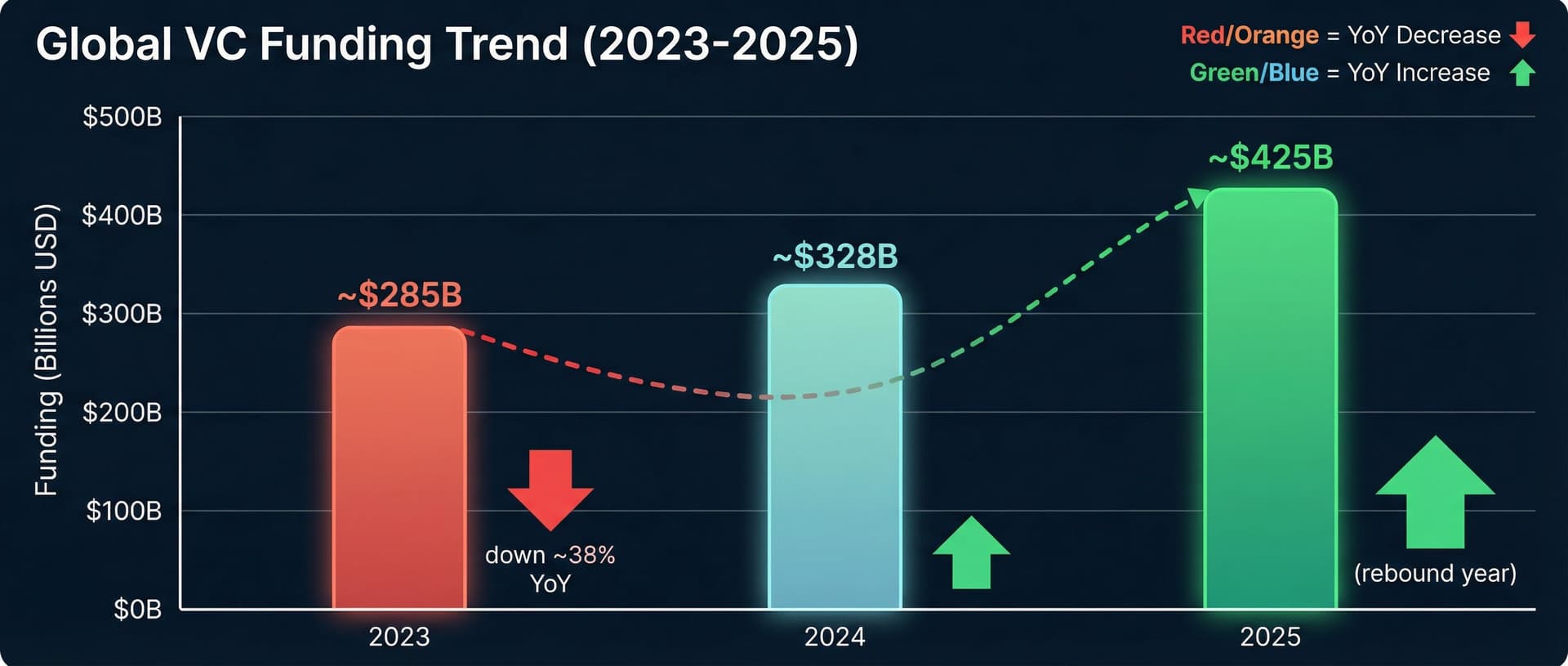
That rebound is important.
Tech capital didn’t vanish. It rotated. Investors became selective, then returned to sectors showing productivity leverage — particularly AI infrastructure, security, and enterprise efficiency platforms.
Investor enthusiasm around AI funding has cooled compared with the breakneck pace of 2024–2025. After record levels of venture investment — global AI startup funding surpassed $200 billion in 2025, up roughly 75% from about $114 billion in 2024 — momentum began to ease in late 2025 as deal volume slowed and investors became more selective. Reports show early-stage AI funding declined approximately 30–40% year-over-year in recent quarters, even as total capital deployed remained historically elevated. Public markets reflected a similar recalibration, with AI-heavy equities pulling back and capital rotating toward companies demonstrating clearer near-term revenue and measurable productivity gains.
2. Layoffs: Restructuring, Not Sector Collapse
Layoffs remain one of the clearest signals people feel. According to Challenger, Gray & Christmas:
At the same time, Challenger notes that restructuring, cost control, and economic conditions are leading reasons cited for cuts — not demand disappearance.
3. Hiring Has Slowed — And That’s the Quiet Signal
Often the bigger story is not layoffs but hiring restraint.
Challenger’s 2025 data shows that companies are not aggressively expanding headcount.
They are prioritizing productivity per employee.
That’s a maturity shift.
4. Growth Has Normalized — It Hasn’t Disappeared
Public tech firms are still growing, but at moderated rates compared to the 2010s.
Large-cap tech revenue growth in 2025 generally sits in mid-single to low-double digits depending on segment (cloud, AI infrastructure, enterprise SaaS).
This reflects:
In mature markets, growth is harder to capture — and that increases pressure on margins and efficiency.

5. AI’s Role — Real, But Contextual
AI investment is rising significantly in 2025–2026.
Crunchbase notes AI as a dominant funding category in 2025’s rebound year. Meanwhile, enterprise AI adoption continues accelerating in automation, internal copilots, workflow compression, and infrastructure optimization.
But here’s the key:
In an efficiency-focused market, AI becomes attractive because it helps companies respond to maturity pressure.
6. The Labor Market Is Polarizing, Not Collapsing
Even amid restructuring, core technical roles remain durable.
According to the U.S. Bureau of Labor Statistics (May 2024 data, latest full dataset available) data and security roles are among faster-growing occupations.
The market isn’t shrinking uniformly. It’s reallocating.
7. What This Really Is: Operational Maturity
Here’s the cleanest way to frame 2025–2026:
Tech is transitioning from:
Growth subsidized by cheap capital to growth filtered by efficiency and leverage.
A Friendlier Bottom Line
If you zoom out, tech in 2026 looks less chaotic than it feels.
Capital is flowing again — but more carefully.
Hiring continues — but more selectively.
Investment remains strong — but more ROI-driven.
That’s not decline.
That’s an industry growing up.
References & Further Reading
About the Author

Related Articles

What we built this week - with Ai p4
Is your business being served by Ai agents?

Can ChatGPT Find Your Business? We Built a Free Tool to Find Out.
We built the Frank Business Diagnostic, a free scanner that looks at your business from the perspective of AI and search technology and identifies areas that may be limiting your visibility.
