
Why We Decided to Build Our Own Internal Software
When we started building out our new business operations, I never really assumed we’d rely entirely on off-the-shelf software.
Not because existing platforms are bad.
A lot of them are actually pretty impressive.
But I already understood how we wanted the business to operate.
I knew where bottlenecks tend to happen. I knew the workflows we cared about. I knew the visibility we wanted across the operation.
And more importantly, I realized something that probably wasn’t true even a few years ago:
Small businesses can now build serious internal tools without needing a giant development team.
AI changed that equation fast.
Building a Solution NOW
Five years ago, building custom operational software for a small business would’ve sounded excessive.
Today, it’s surprisingly realistic.
Between modern APIs, cloud platforms, lightweight frameworks, and AI-assisted development tools, the barrier to building internal systems has dropped dramatically.
You no longer need:
You mostly need:
That last part matters more than people think.
Because the hard part usually isn’t the coding anymore.
It’s understanding the business deeply enough to build something useful.
We Didn’t Need More Features
This was never about trying to build “the next software platform.”
Honestly, I wanted fewer moving parts.
Less operational clutter.
Less switching between systems.
Less time spent trying to figure out where information lived.
Because once you really map out how a business operates day-to-day, you realize how much energy disappears into tiny interruptions:
None of those problems sound major individually.
But together they create constant operational drag.
Most growing businesses don’t notice it happening because it builds slowly over time.
AI Doesn’t Replace Experience — It Amplifies It
I think a lot of people misunderstand what AI is actually changing.
AI doesn’t magically understand your business.
It doesn’t know your workflows.
It doesn’t understand your operational priorities.
You still need that part.
What AI changes is the speed of execution.
If you already understand the operation, AI dramatically reduces the friction between:
That changes what smaller companies are capable of building internally.
Especially businesses with specialized workflows that don’t cleanly fit into generic software categories.
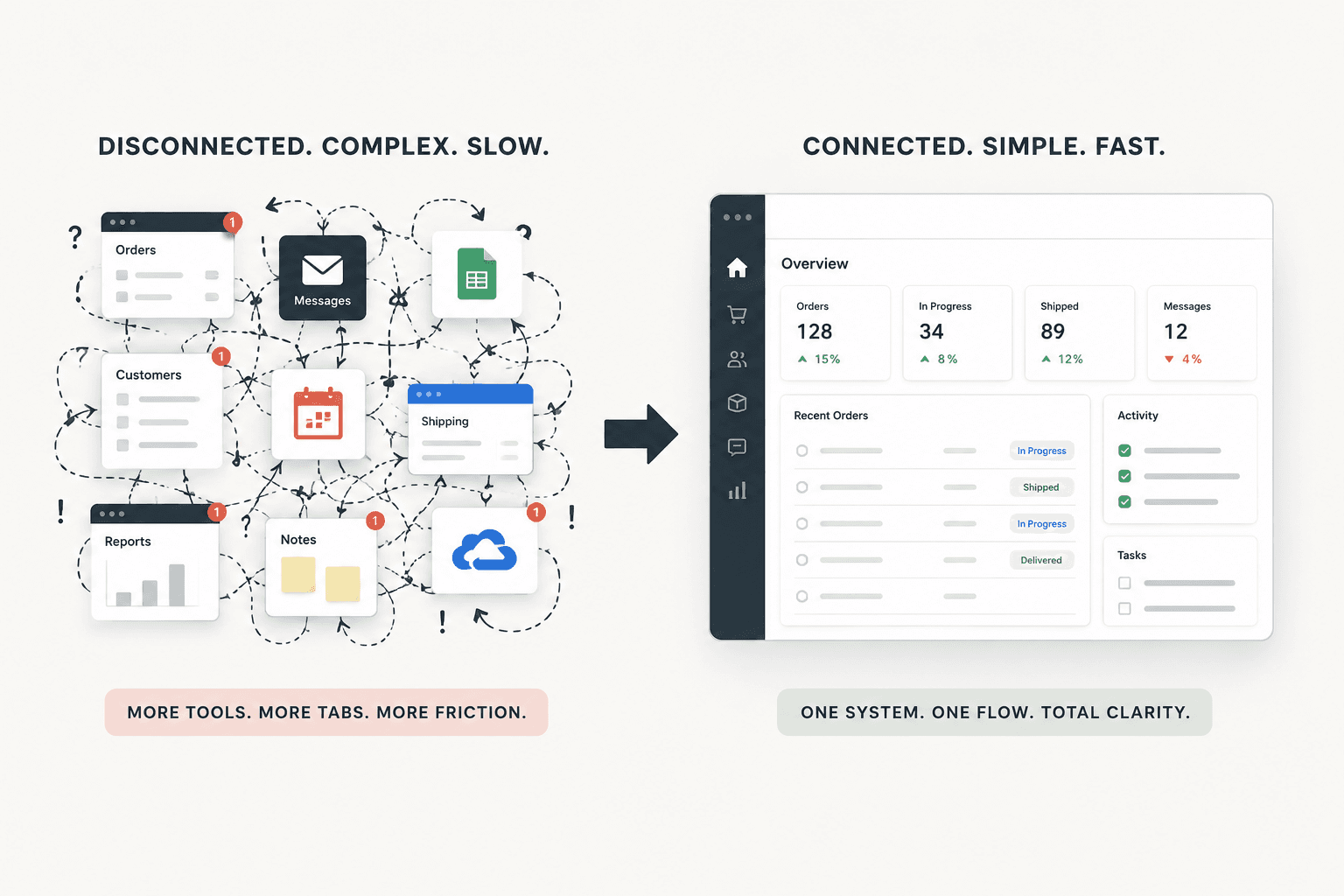
Keep it SIMPLE Stupid
At the end of the day, we’re not trying to build software for the sake of building software.
We’re trying to build cleaner operations.
Cleaner communication.
Cleaner visibility.
Cleaner handoffs between people and processes.
That’s really the entire goal.
Because operational friction has a way of eventually showing up everywhere:
The more we worked through the business operationally, the clearer it became:
Good systems aren’t really about technology.
They’re about reducing friction so people can focus on the work that actually matters.
About the Author

Related Articles

What we built this week - with Ai p4
Is your business being served by Ai agents?

Can ChatGPT Find Your Business? We Built a Free Tool to Find Out.
We built the Frank Business Diagnostic, a free scanner that looks at your business from the perspective of AI and search technology and identifies areas that may be limiting your visibility.
