
An AI Visibility Scanner
This week's build started with what sounded like a pretty simple question:
Can we build a tool that looks at a business the way machines do instead of the way people do?
Turns out, that question gets complicated pretty quickly.
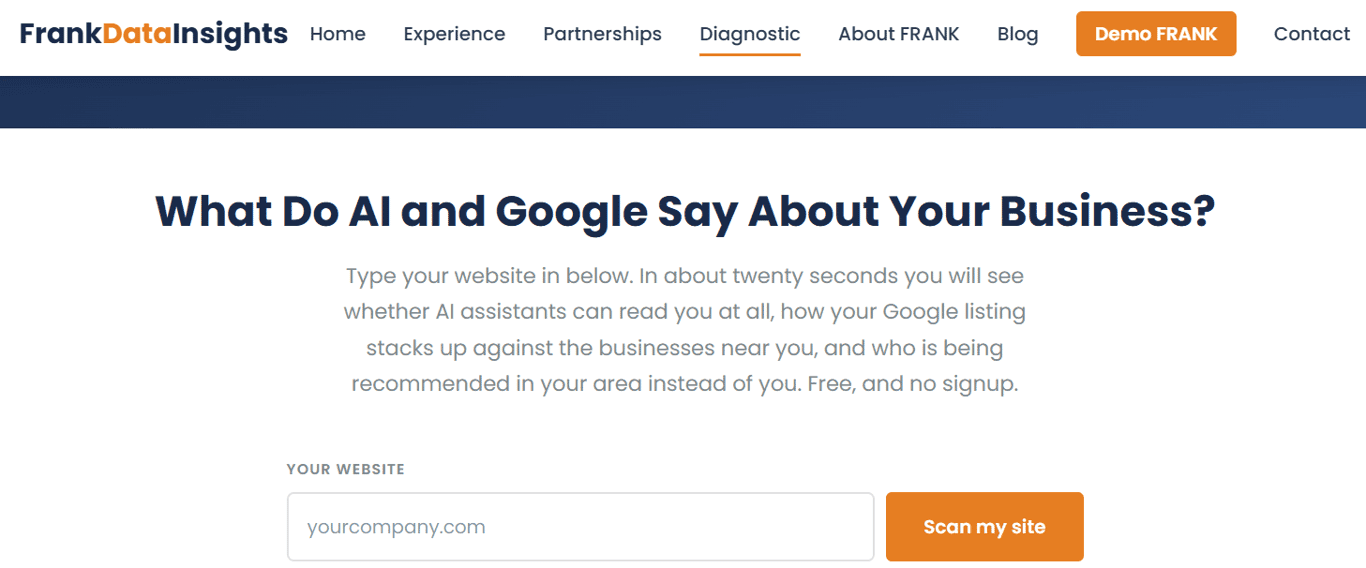
For #4 of What We Built With AI This Week, we built the Frank Business Diagnostic — a scanner designed to evaluate whether a business is giving search engines and AI systems the information they need to understand who that business is, what it does, where it operates and how it compares with competitors.
And unlike some of our other builds, this one is available for anyone to try.
The first version is live and the initial scan is free:
frankdatainsights.com/diagnostic
Building the Scanner
One of our first decisions was that we didn't want to simply look at what a website looks like in a browser.
A website can look fantastic to a person and still do a poor job of communicating information in a way machines can easily interpret.
So the scanner starts by retrieving and analyzing the underlying content of the website.
Then we began breaking the problem into individual signals.
Can we identify the business?
Does the site clearly tell us the business name?
Can we determine where it operates?
Can we identify a physical address or service area?
Can we identify how to contact it?
Is there a phone number and other basic business information?
Can we connect the dots?
Does the website connect the business to its other profiles and sources across the web?
Those individual checks became part of the scoring model.
But that was only the first layer.
The Harder Part: Context
Finding a phone number is relatively easy.
Understanding what kind of business you're looking at is much more interesting.
We needed the system to take the information it collected and determine what trade or category the business actually operates in.
That's important because the real question isn't simply:
"Is this a good website?"
It's:
"How does this business compare with the businesses competing for the same customers?"
So the process became:
Website → Extract business information → Understand the business → Identify its market → Find competitors → Compare signals → Score the results
That's where this stopped feeling like a simple website scanner.
Then We Had to Make the Score Mean Something
This was another interesting part of the build.
It's easy to create a score.
It's much harder to create a score that actually tells a business owner something useful.
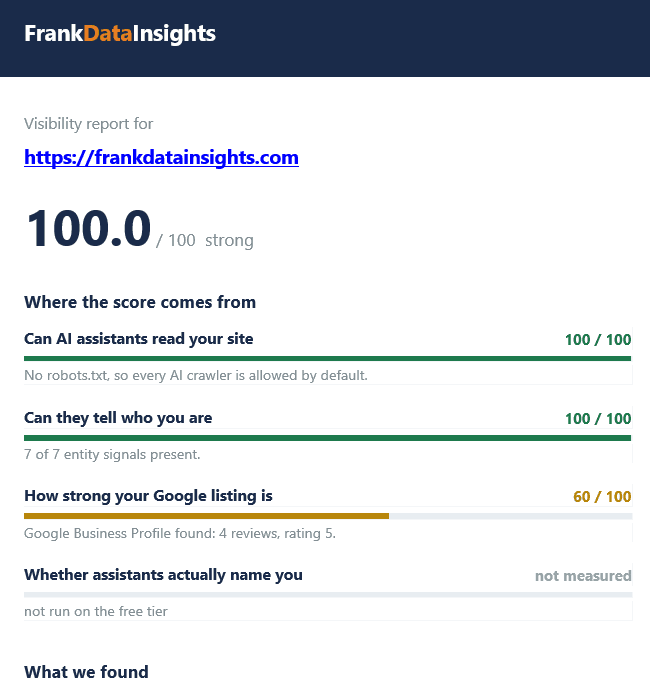
We eventually settled on seven core criteria for the initial scanner. A score of 100 means the business has satisfied those criteria.
But we intentionally did not make 100 mean:
"You're #1 in your market."
Those are two completely different things.
A business can have everything technically in place and still be getting beaten by competitors.
And we learned that firsthand.
Then We Turned It on Our Own Businesses
One of the first things we did was point the scanner at two of our own businesses.
The results?
Frame Fiesta: 82/100
Frank Data Insights: 63/100
And I was actually happy to see that.
If we built a scanner that immediately told us everything we were already doing was perfect, I would have questioned whether we'd built anything useful.
Instead, it identified areas where both websites could do a better job of communicating information to AI and search systems.
So we did exactly what we're asking other business owners to do.
We followed the recommendations.
We made changes.
Ran the scans again.
Found additional issues.
Made more changes.
And tested again.
Today:
Frame Fiesta: 100/100
Frank Data Insights: 100/100
That became one of my favorite parts of this build because we had created more than a scoring system.
We'd created a feedback loop:
Scan → Identify → Recommend → Fix → Rescan → Measure
That's much more useful to me than simply putting a number on a dashboard.
But 100 Didn't Mean We Were Done
This is where things got even more interesting.
Frame Fiesta now scored 100, but the scanner still showed that five competitors had stronger positive-review profiles than we did.
We're a newer physical location, so that makes sense.
But now we had something actionable.
Instead of saying:
"We need to do more marketing."
We could say:
"We need to build our in-store review profile and start closing that gap."
That's a much better business decision.
And it reinforced an important distinction we built into the tool:
A 100 means you're meeting the criteria we're currently measuring. It does not mean you're winning your market.
Then We Built the Second Layer
The free scanner essentially answers:
Are the conditions right for AI and search technology to understand this business?
Our full diagnostic tackles the harder question:
Does AI actually recommend it?
That's a very different problem.
Instead of only analyzing the business's website and public presence, we create the kinds of buying questions its customers might actually ask AI assistants.
Then we test them.
Does the business appear?
Who gets recommended instead?
Which competitors consistently show up?
And maybe most importantly:
If we're absent, who is taking our place?
The diagnostic then looks deeper into those competitors, including what their customers are saying about them, to identify weaknesses and opportunities.
Sometimes the answer isn't spending more money trying to beat your biggest competitor at what they already do well.
Sometimes it's identifying what they don't do well and winning there.
At that point, we're no longer simply scanning a website.
We're starting to build a dataset around how that business exists in an AI-driven discovery environment.
Where AI Helped Us Build It
And this is the part that makes it What We Built With AI This Week.
AI wasn't just something the finished product was designed to measure.
AI was part of the development process.
We could start with an idea like:
"We need to determine whether a machine can clearly identify this business."
Then break that into smaller problems.
Define what information we'd need.
Build the logic.
Test it against real businesses.
Find where it failed.
Change the logic.
Run it again.
That build → test → fail → fix → test again cycle is where AI continues to change development for me.
I'm not a traditional software developer.
And that's part of why I'm doing this series.
I'm a business person who understands the problem I'm trying to solve.
Increasingly, I'm finding that AI can help bridge the technical gap between understanding a business problem and building something that can actually solve it.
But there's an important distinction.
AI can help tremendously with the code between those questions.
You still have to know what you're trying to build.
You have to define:
What problem are we trying to solve?
What information do we need?
What should the system do with it?
How do we know whether the answer is right?
That part still requires business knowledge, testing and judgment.
This Scanner Isn't Finished
And I don't think it ever really will be.
That's intentional.
AI search and discovery are changing too quickly for us to build this tool, put a version number on it and walk away.
As AI platforms evolve in how they discover, interpret and recommend businesses, the scanner will evolve with them.
We'll add new signals.
We'll adjust how existing signals are evaluated.
We'll add new features as we find better ways to measure visibility.
And we'll change or remove things that stop being relevant.
That means something else:
What earns a business a 100 today may not necessarily earn it a 100 six months from now.
And I think that's one of the more interesting parts of this project.
We're not trying to build a static SEO checklist.
We're trying to build a tool that evolves alongside the technology it's measuring.
What We Learned From Build #4
This week's project reinforced something I've been learning throughout this series.
AI has dramatically shortened the distance between:
"I wish I had a tool that could do this."
and
"Let's build it."
But AI didn't decide what the scanner should measure.
It didn't decide what would make the results useful to a business owner.
It didn't decide that a score of 100 shouldn't automatically mean "you're doing great."
And it didn't look at our Frame Fiesta results and decide that reviews should become a business priority.
Those are business decisions.
AI helped us turn those decisions into a working product much faster.
And that's becoming one of my biggest takeaways from this entire series:
The ability to write code is becoming less of a barrier.
The ability to clearly define the problem you're trying to solve may actually be becoming more important.
For Build #4, our problem was:
How do we know whether AI and search technology can properly understand our business—and what should we fix if they can't?
We started with two of our own businesses scoring:
Frame Fiesta — 82
Frank Data Insights — 63
We used the recommendations.
We changed the sites.
We tested again.
Today, they're both at 100.
And as AI changes, we'll keep changing the scanner with it.
Build #4 Is Live
This is one of the builds in this series that you can actually test yourself.
Frank Business Diagnostic
frankdatainsights.com/diagnostic
Run your business through it.
But don't just look at the score.
About the Author

Related Articles

Can ChatGPT Find Your Business? We Built a Free Tool to Find Out.
We built the Frank Business Diagnostic, a free scanner that looks at your business from the perspective of AI and search technology and identifies areas that may be limiting your visibility.

